Why One Account Is the Issue
Google is not simply a collection of useful tools. It is an interlocking system of identity, distribution, data collection, and advertising. Alphabet tells investors that Google Services generates revenue primarily from advertising, and its privacy policy describes collecting activity, device, location, and content-related information; analyzing content with automated systems; and linking activity from third-party sites and apps that use Google advertising or analytics services. A company paid to improve advertiser results has a rational incentive to make behavior measurable and attention monetizable—an incentive fundamentally different from minimizing what the provider can learn.
Concentration is what turns that incentive into leverage over you. When the same account controls your inbox, recovery addresses, browser sync, phone, purchases, documents, photos, and third-party sign-ins, leaving any one service becomes harder—every additional dependency raises the cost of saying no later. It also creates a large blast radius: one suspension, lockout, policy change, legal demand, or security incident can disrupt parts of life that should never have shared a single point of failure.
Privacy controls are not independence
My Activity, ad controls, and deletion tools can reduce some collection or retention. They do not change who operates the ecosystem, which defaults steer people into it, or how many essential functions depend on the same identity. A control panel inside a concentrated system is not a substitute for having a credible exit.
You Are the Product Google Sells Access To
For Google’s advertising-funded services, you are not the customer. You are the supply. Your searches, viewing habits, location signals, app activity, device identifiers, purchases, and activity across sites using Google services help build predictions about what will hold your attention and what you may do next. Google’s paying customers—advertisers—buy the opportunity to reach audiences assembled from those signals, targeted by criteria such as affinity, demographics, life events, location, and custom segments.
Google says it does not “sell your personal information.” The claim is narrow. Google does not need to transfer a dossier with your name on it: it keeps the profile, decides you belong in a commercially valuable audience, runs an auction for access to that audience, and charges when an ad is shown, clicked, or produces a measurable result. Keeping the profile inside Google is what lets the company monetize access to the same person again and again.
“We do not sell your personal information” is not “we do not monetize your data”
Being “the product” does not require a database row to change hands. Your attention, behavior, classification, and predicted susceptibility are the inventory the transaction is built around. The advertiser buys access; Google keeps the machinery and the profile.
Tracking Reaches Far Beyond Google’s Own Sites
Much of Google’s collection happens on other people’s websites and apps. Pages that embed Google Analytics, AdSense, reCAPTCHA, Fonts, or Maps make requests to Google as you browse, and Google’s privacy policy confirms it links activity from partner sites and apps to its advertising systems. For years Google kept DoubleClick’s web-browsing records separate from account identities; in 2016 it quietly dropped that separation, allowing browsing histories collected across the web to be combined with the personal identity in a Google account.
Even “private” modes collect. Chrome’s Incognito window stopped Chrome from saving history locally, but Google’s servers and embedded trackers kept observing the browsing; a class action over that gap ended in 2024 with Google agreeing to destroy billions of records of Incognito-era browsing data and to state plainly in the disclosure that Google still collects data in Incognito mode.
Location deserves special mention. Android devices and Google apps generated location trails so comprehensive that police agencies served “geofence warrants” on Google’s Sensorvault database to identify everyone near a crime scene. In late 2023 Google announced it would store Location History on the device rather than on its servers—a change worth noting for what it concedes: only re-architecting where data lives, not another setting, actually limited that access.
What Regulators and Courts Found
Google’s privacy policy is one source, not the final word. Across fifteen years, regulators and courts on four continents have found or alleged that the company’s actual practices crossed legal lines or contradicted what users were led to expect:
- 2011 — FTC consent order (Google Buzz). Buzz auto-exposed Gmail users’ frequent contacts; the FTC charged Google with deceptive privacy practices, and the settlement placed Google under a comprehensive privacy program with independent audits for 20 years.
- 2012 — $22.5 million FTC penalty (Safari). Google bypassed Safari’s default cookie blocking to place DoubleClick tracking cookies while telling Safari users they were protected—then the largest civil penalty in FTC history.
- 2013 — $17 million multistate settlement (Safari). Thirty-seven states and D.C. settled the same conduct.
- 2019 — €50 million CNIL fine (GDPR). France’s regulator found Google failed to clearly inform users or obtain valid consent for ads personalization.
- 2019 — $170 million FTC/New York settlement (YouTube). YouTube collected persistent identifiers from children without parental consent and monetized them with targeted ads.
- 2020 and 2022 — €100 million and €150 million CNIL fines (cookies). Advertising cookies were placed without consent, and refusing tracking was made harder than accepting it; Google added a “Reject all” button afterward.
- 2022 — A$60 million Federal Court penalty (Australia). The court found Google misled Android users about location settings: data kept flowing under a second default-on setting while “Location History” was off.
- 2022 — $85 million Arizona and $391.5 million 40-state settlements (location). State attorneys general alleged Google continued collecting and monetizing location after users tried to turn tracking off; the multistate agreement was the largest consumer-privacy settlement led by U.S. states at the time.
- 2023 — $93 million California settlement (location). The state alleged Google’s location-privacy practices misled users while location data fed profiling and ads.
- 2024 — Incognito settlement (Brown v. Google). To resolve claims that private browsing was not private, Google agreed to delete billions of browsing records and rewrite its disclosures.
Settlements are not trial judgments, and allegations should not be mislabeled as admissions. But the pattern is consistent: users were shown one thing about privacy controls while collection continued through another mechanism, and it took regulators, courts, or litigation—not the settings page—to surface the difference. That is why evaluating Google requires looking at incentives, technical behavior, and enforcement records, not repeating the company’s current policy language.
A Pattern of Overreach, Not a Bad Week
The fines are the enforceable tip of a longer record of collecting first and explaining later:
Street View payload collection (2006–2010). Street View cars did not just photograph roads; they recorded traffic from unencrypted home Wi-Fi networks—including emails, URLs, and passwords—in more than 30 countries. The FCC fined Google $25,000 for obstructing its investigation and released a report showing the collection was designed in on purpose, contradicting Google’s initial “mistake” explanation.
Gmail content scanning (2004–2017). For thirteen years Google scanned the contents of consumer Gmail to target advertising, a practice it defended in court and ended only in 2017 as it chased business customers who refused to accept it. Message content is still processed for features like Smart Compose unless you turn those off.
Google+ exposure and delayed disclosure (2018). An API bug exposed profile data of up to half a million accounts. Google disclosed it months later while announcing the product’s shutdown; contemporaneous reporting showed the delay was partly driven by fear of regulatory scrutiny.
Project Nightingale (2019). Google’s cloud deal with the Ascension hospital network gave it access to tens of millions of U.S. patient records—names, diagnoses, lab results—without patients or doctors being told.
The Nest microphone nobody mentioned (2019). Google’s Nest Secure hub shipped with a microphone that appeared in no specification until a software update enabled it; Google called the omission an error.
Individually, each has an explanation. Together they describe a company whose default is to collect broadly and disclose narrowly—exactly what its advertising incentives predict.
Who Else Gets Access
Data concentrated in one place is data that can be demanded from one place. Google discloses information in response to legal process and enforceable government requests worldwide, and its Transparency Report counts those requests in the hundreds of thousands of accounts per year. Documents leaked in 2013 placed Google among the providers whose data the NSA’s PRISM program could access under U.S. surveillance law; Google denied providing any “back door.” Geofence warrants against its location database, discussed above, show the same dynamic domestically: the richer the central dataset, the more attractive it is to compel.
The China record
Google’s entanglements with the Chinese state are documented, not hypothetical. In 2019, China’s state broadcaster CCTV paid to run anti-protest advertising on YouTube during the Hong Kong demonstrations, and Google separately removed 210 YouTube channels tied to a coordinated influence operation about the protests. Google confirmed producing some non-content user data for three of 43 Hong Kong authority requests in late 2020, after saying it had stopped handling such requests directly. A 2025 EPIC/ICCL complaint asks the FTC to investigate whether Google’s real-time ad bidding exposed Americans’ data to companies in Beijing and Shenzhen—a documented accusation Google disputes, not a finding. And in 2018 Google internally prototyped Dragonfly, a censored Chinese search engine, abandoning it only after employee and public backlash.
Defaults and Market Power
Scale is not incidental to the privacy question; it is what makes the bargain hard to refuse. In 2024 a federal court ruled that Google illegally maintained a monopoly in general search, sustained in part by billions of dollars a year paid to make Google the default on phones and browsers. In 2025 a second court found Google holds illegal monopolies in advertising technology—the machinery on the publisher side of the web’s ad economy.
Market power changes what your consent means. When search, the browser, the phone platform, and the ad infrastructure are the same company—and defaults are purchased so most people never choose them—“you agreed to the terms” describes a formality, not a negotiation. It also means the profile follows you: leaving one Google product while the rest of the web embeds Google’s trackers reduces, but does not end, the observation.
What You Can Do
None of this requires abandoning every Google product by Friday. It requires ending the arrangement where one advertising company holds your identity, your data, and your exit costs at the same time. Three practical moves, in order:
- See the whole bargain. The Modern Privacy Bargain explains what any data-funded service can collect, infer, and retain—the questions in it apply to Google’s replacements too.
- Plan a reversible exit. The migration guide walks through inventorying dependencies, exporting and verifying your data, and moving mail, files, calendars, and photos one category at a time—without locking yourself out.
- Choose replacements whose incentives differ. A provider you pay with money, whose encryption keeps content unreadable to it, has structurally less to monetize. NDEVR OWL is built on that model: files, documents, sharing, chat, calls, and calendars in one workspace with client-side encryption and no advertising business—see plans and pricing and the encryption guide for exactly what the provider can and cannot see. OWL replaces the storage-and-collaboration core, not Search, Maps, or YouTube—and no single provider should inherit your entire digital life again.
References & Further Reading
- Wikipedia, Privacy concerns with Google — a broader catalog of incidents than this page covers.
- Alphabet Investor Relations, Google Services segment and revenue model.
- Google, Privacy Policy.
- Google Ads Help, Personalized advertising targeting criteria.
- ProPublica, Google has quietly dropped ban on personally identifiable web tracking (2016).
- The Guardian, Google to destroy billions of browsing records in Incognito settlement (2024).
- Wikipedia, Geofence warrant; Google, Location History moves on-device (2023).
- U.S. Federal Trade Commission, Google Buzz consent order (2011); Safari tracking settlement (2012); YouTube children’s privacy settlement (2019).
- New York Attorney General, $17 million multistate Safari tracking settlement (2013).
- CNIL, €50 million GDPR penalty (2019); €150 million cookie-consent fine (2022).
- Australian Competition and Consumer Commission, A$60 million penalty for misleading location representations (2022).
- Arizona Attorney General, $85 million location settlement (2022); NPR, $391.5 million 40-state location settlement (2022).
- California Department of Justice, $93 million location-privacy settlement (2023).
- Wired, FCC report on Street View Wi-Fi collection (2012).
- Google, Ending consumer Gmail ad scanning (2017); Project Strobe and the Google+ API exposure (2018).
- The Guardian, Project Nightingale health-data reporting (2019); NSA PRISM program reporting (2013).
- BBC News, Nest Secure’s undisclosed microphone (2019).
- Sky News, Chinese state media advertising on YouTube (2019); Google Threat Analysis Group, Hong Kong influence-operation channel removals (2019); Business Insider, Hong Kong data disclosures (2021); EPIC/ICCL Enforce, FTC complaint on real-time bidding (2025); The Intercept, Dragonfly censored-search prototype (2018).
- U.S. Department of Justice, Search monopoly ruling (2024); CNBC, Ad-tech monopoly ruling (2025).
- Google Transparency Report, Global government requests for user information.
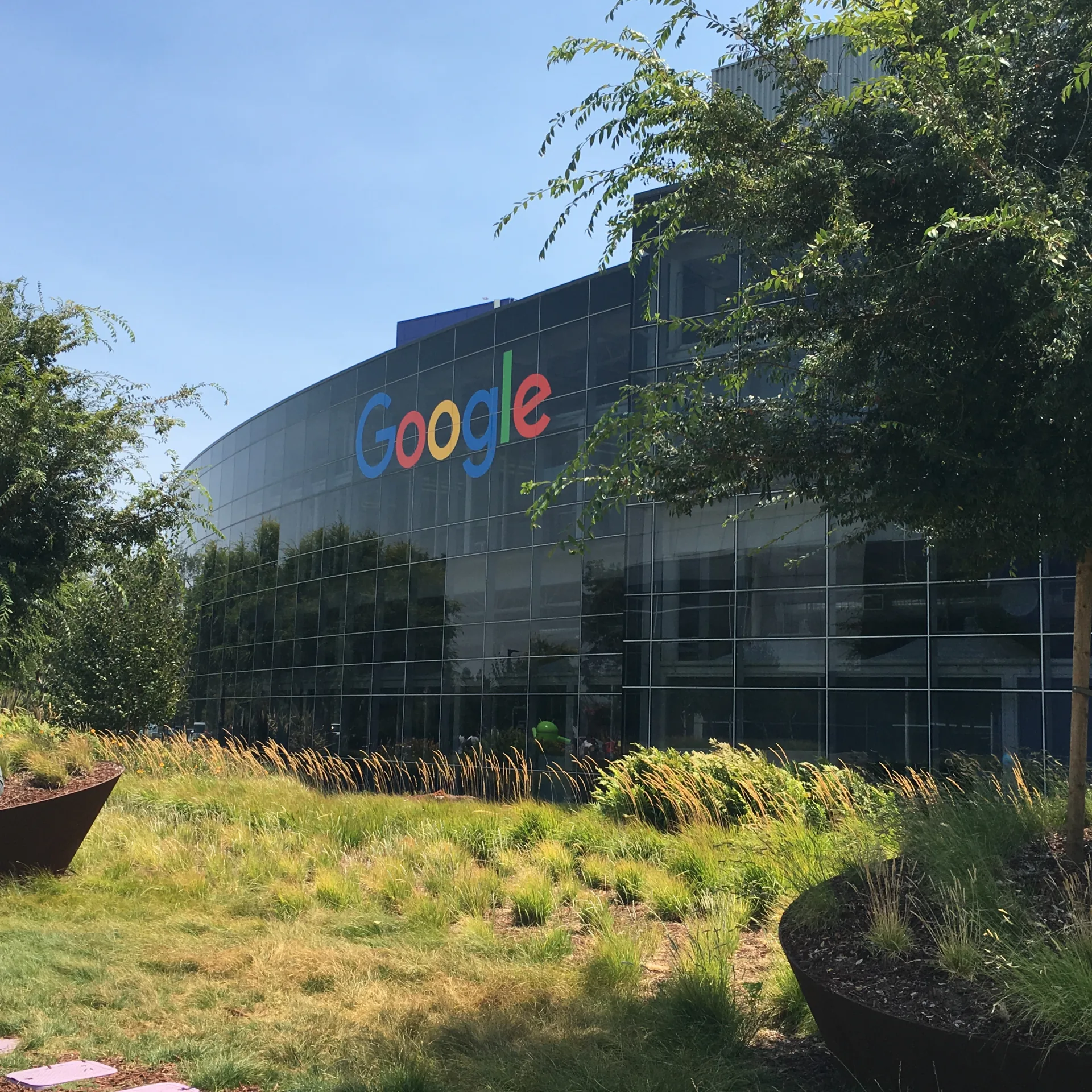
- Wikimedia Commons, Googleplex HQ image and license.