One Upload, Several Possible Uses
When you ask an AI assistant to summarize a contract, debug source code, edit a photo, or transcribe a meeting, the service needs the input long enough to produce an answer. Everything after that is a policy and architecture choice. The input may be deleted promptly, retained for history, scanned for abuse, sampled for evaluation, reviewed by people, shared with subprocessors, or selected to improve future systems.
These branches vary by provider, account type, region, administrator setting, and whether the user submits feedback. A company may make stronger commitments for business or API customers than for a free consumer product. Treat product names as insufficient evidence; inspect the terms for the exact surface you are using.
What Training Changes
Traditional cloud storage keeps a file so it can return that file later. Model training uses examples to change a statistical system. The resulting model does not usually contain a neat folder of source documents, but that does not make the sources irrelevant or automatically anonymous. Training can encode patterns, distinctive phrases, styles, relationships, and occasionally details from particular examples.
The consent problem follows. A photo can contain bystanders. A meeting transcript can contain coworkers and customers. A code sample may embody an employer’s trade secret. The person pressing “send” may not own every right or have authority to donate every person’s data to product development.
The European Data Protection Board has emphasized that whether a model is anonymous must be assessed case by case. A model should be very unlikely both to identify people from its training data and to yield their personal data through queries. Merely calling a model anonymous does not settle the question.
Memorization and Inference
NIST identifies two related privacy risks. First, a model can memorize and reveal sensitive material from training examples, particularly under adversarial probing. Second, a model can infer sensitive information that was never stated directly by joining clues across sources. Those inferences can cause harm whether they are accurate or confidently wrong.
Exposure
A distinctive sequence, image, or fact may be reproduced or extracted under the right conditions.
Membership
An attacker may try to determine whether a person or record appeared in the training set.
Inference
Separate clues can be assembled into health, identity, relationship, financial, or behavioral conclusions.
Do not confuse a chat history switch with the whole pipeline
A setting that hides or deletes conversations from your interface may not describe safety logs, backups, feedback samples, or training. Look for separate, explicit answers about retention, human review, subprocessors, and model improvement.
The Workplace Problem: Accidental Corporate Disclosure
Generative AI makes disclosure feel productive. An employee can paste a draft contract to find risky clauses, upload a customer spreadsheet for a formula, submit source code for debugging, or summarize a board memo in seconds. If that tool is not approved for the data class, the employee may have just copied company information into a third party’s systems.
The UK National Cyber Security Centre advises against placing sensitive information in public-LLM queries and recommends understanding whether provider staff, partners, or contractors can see data used for prompts, fine-tuning, or augmentation. The concern is broader than training: stored queries can be exposed by a breach, a configuration mistake, an account takeover, or a later change in ownership and policy.
That makes AI governance part of trade-secret protection. Confidentiality labels and nondisclosure agreements are weakened if daily workflows encourage employees to paste secrets into unapproved assistants.
Evaluate the Exact AI Service
Training
Is customer content used to train or improve models? Is the control opt-in or opt-out? Does feedback follow different rules?
Retention
How long are prompts, outputs, files, abuse-monitoring records, and backups kept? Can an administrator shorten it?
People
When may employees or contractors review content? Is access logged, limited, and covered by confidentiality duties?
Boundaries
Which subprocessors, regions, plugins, connectors, and external tools receive the data after the main service?
Ownership
Who owns inputs and outputs, and what license does the provider receive to host, analyze, or improve the service?
Exit
Can you export and delete data? What remains in derived datasets or already-trained models after deletion?
Use AI Without Giving It Everything
- Remove names, account numbers, addresses, credentials, hidden document history, and unrelated columns before upload.
- Use synthetic examples that preserve the shape of a problem without exposing the real record.
- Send the smallest relevant excerpt instead of a complete repository, mailbox, medical record, or contract set.
- Keep secrets, unreleased designs, customer lists, private keys, and regulated data out of public tools.
- Use an organization-approved enterprise, API, private-cloud, or self-hosted route whose controls match the data class.
- Recheck terms and administrator settings periodically; a service’s privacy posture can change.
References & Further Reading
- U.S. National Institute of Standards and Technology, Artificial Intelligence Risk Management Framework: Generative AI Profile (2024).
- UK National Cyber Security Centre, ChatGPT and Large Language Models: What’s the Risk?
- European Data Protection Board, Opinion on AI Models and Personal Data (2024).
- U.S. Cybersecurity and Infrastructure Security Agency, Stay Safe Online When Using AI.
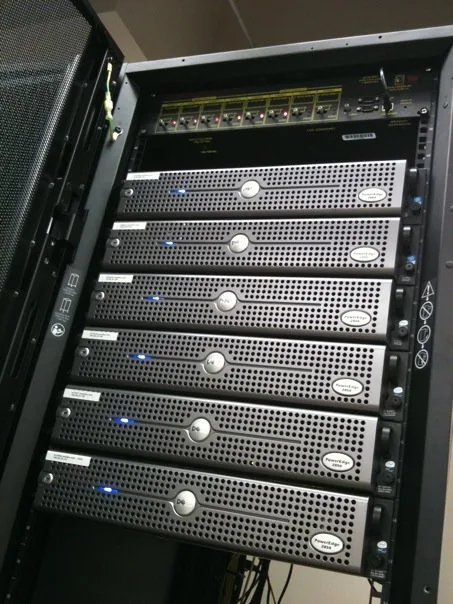
- Wikimedia Commons, data-center image and license.

Where OWL Can Fill the Gaps
NDEVR OWL can keep CSD source-document, message and working-file payloads end-to-end encrypted so, with client-held decryption keys, the storage provider receives no usable content key. Operational metadata remains visible, and SSD or a deliberately enabled AI connector changes that trust boundary. This gives teams a private staging path before deliberate AI use and helps them share source material with named people.
Encryption cannot protect plaintext after you intentionally submit it to an external AI model. The responsible boundary remains explicit: keep the source private, select only the minimum context needed, and apply the chosen model provider’s own retention and training terms to whatever crosses that boundary.