From a Switch to a Sphere
A classical bit is a switch. It sits in one of two positions, and a logic gate moves it between them. Every digital computer is built from billions of these switches, and the whole design rests on each one being definitely 0 or definitely 1 at every moment.
A qubit has the same two readouts, but between measurements its state is richer. It is described by two numbers called amplitudes, one for 0 and one for 1. The probability of each readout is the square of its amplitude, so the two squares add to 1. Written out, the state is α|0⟩ + β|1⟩, where |0⟩ and |1⟩ name the two readouts and α and β are the amplitudes. The angular brackets are standard notation from physics. They are labels, nothing more.
Because the amplitudes are constrained, every possible state fits on the surface of a sphere. The north pole is |0⟩: the amplitude for 0 is 1 and the readout is certain. The south pole is |1⟩. Points on the equator are equal mixes, such as |+⟩, where both amplitudes are 0.71. Moving from the north pole toward the south pole shifts the odds from 0 toward 1. Moving around the sphere at a fixed latitude changes the phase, a quantity that does not affect the odds of a single measurement but matters as soon as two paths combine.
Why a sphere and not a line
The two amplitudes can be negative, and in general they are complex numbers. A line from 0 to 1 would only capture the odds. The sphere captures the odds and the phase together, which is exactly what gates act on and what interference uses.
Reading a Qubit
Measurement is the only way to get information out of a qubit, and it is blunt. The readout is 0 or 1, drawn at random with the odds set by the state. After the readout, the state is the pole that was read: a measured |+⟩ becomes |0⟩ or |1⟩ and stays there. The superposition does not survive being looked at.
This has consequences that shape every quantum algorithm. A qubit cannot be copied, because copying would require reading it first. A program cannot peek at a qubit halfway through to see how it is going. And the amplitudes themselves are never printed out: learning them takes many identically prepared qubits, many measurements and some statistics, a procedure called tomography.
For the same reason, a qubit cannot carry more than one bit of information from a sender to a receiver, however much structure its direction holds. The direction is real and the operations use all of it, but only one bit comes out at the end. Superposition, Measurement and Interference goes deeper into what a measurement does and why the result is random rather than merely unknown.
Moving a Qubit: Gates
A quantum gate is a rotation of the sphere. It moves every possible state by the same turn, never reads the state, and can always be undone by turning back. A handful of named rotations do most of the work.
| Gate | Rotation | What it does |
|---|---|---|
| X | Half a turn about the horizontal x-axis | Swaps the poles: 0 becomes 1 and 1 becomes 0. The quantum NOT. |
| Z | Half a turn about the vertical axis | Leaves the poles in place and flips the sign of the |1⟩ amplitude. Changes only the phase. |
| H (Hadamard) | Half a turn about the diagonal between x and z | Takes |0⟩ to |+⟩ and |1⟩ to |−⟩. The usual way to create a superposition, and to turn phase back into odds. |
| Rotations by any angle | Any axis, any angle | The general single-qubit gate. Hardware implements it with a timed laser or microwave pulse. |
| CNOT | A conditional X on a second qubit | Flips the target qubit wherever the control qubit is 1. The standard entangling gate, covered in What is Quantum Entanglement? |
Two facts follow. Any single-qubit state can be reached from |0⟩ with at most two rotations. And any quantum program on any number of qubits can be built from single-qubit rotations plus CNOT, which is why those are the operations hardware teams benchmark. The animated walkthrough on What is a Quantum Computer? shows X, H and Z turning the arrow, and then CNOT joining two qubits.
What a Qubit Is Made Of
Any physical system with two distinguishable quantum states can serve as a qubit, provided it can be set, rotated, read and kept isolated for long enough. The hardware in use today picks different systems and pays different prices.
Trapped ions
- A single charged atom held by electric fields in a vacuum.
- Two internal energy levels are |0⟩ and |1⟩. Laser pulses rotate the state.
- Read by shining a laser: the ion glows for one level and stays dark for the other. Very accurate, relatively slow.
Superconducting circuits
- A loop of superconducting metal with a Josephson junction, cooled to about 15 thousandths of a degree above absolute zero.
- The circuit’s two lowest energy levels are the qubit. Microwave pulses rotate it.
- Fast gates, but the state lasts only tens to hundreds of microseconds.
Atoms, photons and spins
- Neutral atoms held in place by focused laser beams.
- A photon’s polarization, horizontal or vertical.
- An electron’s spin in a silicon device. Each platform trades isolation against ease of control.
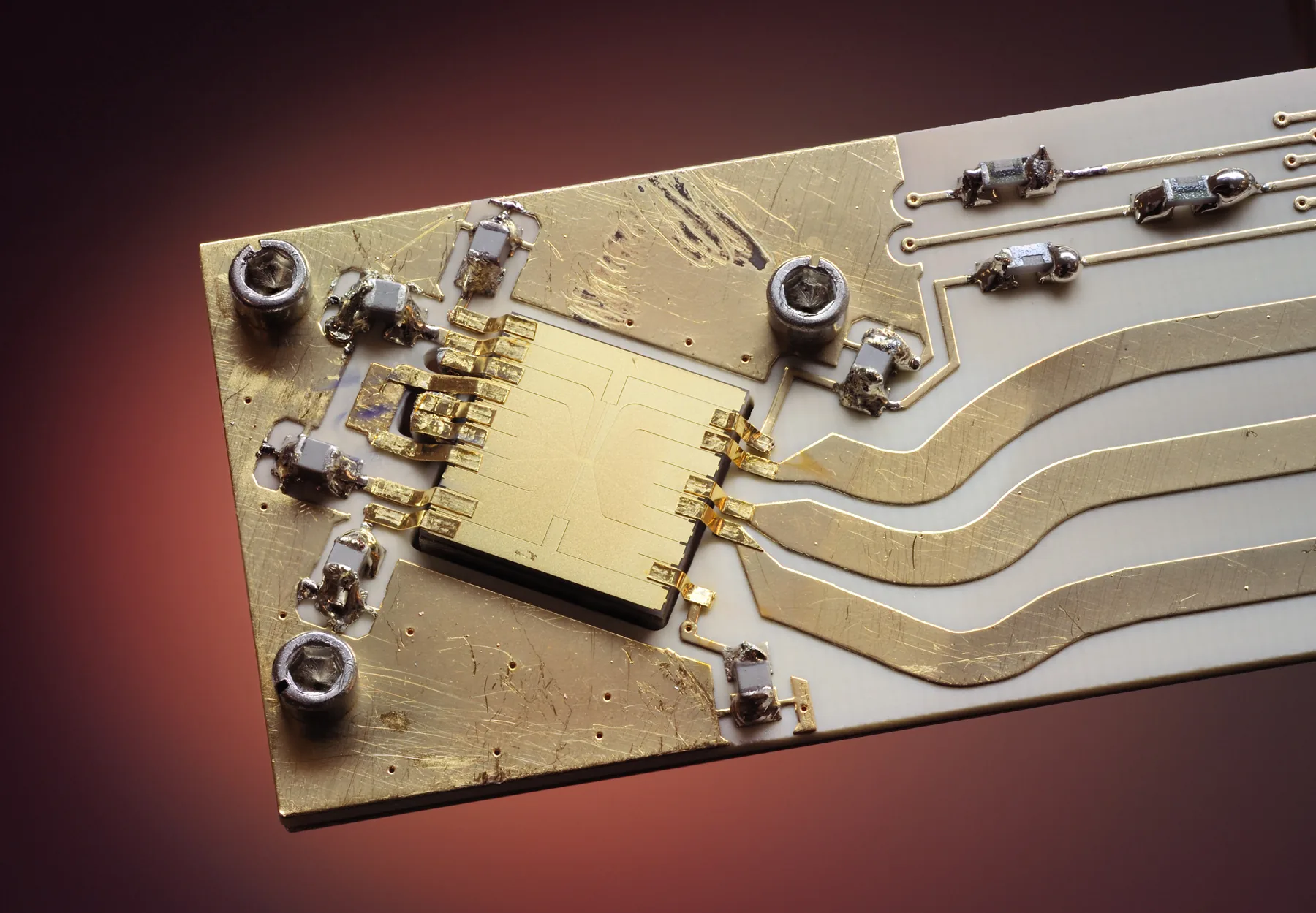

Quantum Hardware and Error Correction compares the platforms and the numbers that matter: how long a qubit keeps its state, how accurately gates turn it, and how many qubits a machine has.
Qubits and Encryption
A single qubit threatens nothing. The threat to encryption needs thousands of logical qubits running Shor’s algorithm, each logical qubit built from many physical ones. The 2017 estimate for a 256-bit elliptic curve, the kind behind P-256, is about 2,300 logical qubits; a 2025 estimate puts RSA-2048 within reach of under a million physical qubits. Today’s machines have roughly a hundred to a thousand physical qubits and a handful of logical ones. Post-Quantum Encryption explains the keys that will stay safe and which of them OWL already uses.
Sources & Further Reading
- M. A. Nielsen and I. L. Chuang, Quantum Computation and Quantum Information (Cambridge University Press, 2010), sections 1.2 (quantum bits) and 4.2 (single-qubit operations).
- IBM Quantum Learning: Basics of quantum information: a free course on the amplitude picture used here.
- The Quantum Atlas: Qubits and How to Make a Qubit, Joint Quantum Institute, University of Maryland.
- D. P. DiVincenzo, “The Physical Implementation of Quantum Computation”, Fortschritte der Physik 48, 771 (2000): the five requirements a physical qubit has to meet.
- M. Roetteler, M. Naehrig, K. M. Svore and K. Lauter, “Quantum resource estimates for computing elliptic curve discrete logarithms”, ASIACRYPT 2017: the source of the 2,330 logical-qubit figure for 256-bit curves.