What Makes a Good Qubit
David DiVincenzo set out the requirements in 2000, and they still frame every hardware announcement. A qubit must be a well-defined two-level system that can be made in quantity. It must be possible to set every qubit to a known starting state. The state must last long enough to run the computation, which means the qubit must be isolated from everything except the control system. There must be a complete set of gates, including a two-qubit gate that can entangle neighbours. And each qubit must be readable at the end.
The requirements pull against each other. A qubit that is well isolated is hard to control, and a qubit that is easy to control is easy to disturb. Each platform is a different compromise between the two.
The Main Platforms
| Platform | The qubit | Strengths | Challenges | Built by |
|---|---|---|---|---|
| Superconducting circuits | The two lowest energy levels of a circuit with a Josephson junction, cooled to about 15 millikelvin and driven by microwave pulses | Fast gates (tens of nanoseconds); made with chip-fabrication tools | States last 0.1 to 1 millisecond; each qubit needs its own wiring into a dilution refrigerator | Google, IBM, Rigetti |
| Trapped ions | Two internal energy levels of a single charged atom held in an electromagnetic trap and driven by lasers | Best gate accuracy; states last seconds or longer; any ion can interact with any other | Slow gates (microseconds to milliseconds); traps get hard to scale past a few hundred ions | Quantinuum, IonQ |
| Neutral atoms | Energy levels of uncharged atoms held in an array of focused laser beams, interacting through highly excited states | Thousands of atoms in one array; layouts can be rearranged mid-computation | Gate accuracy still behind ions; atoms are occasionally lost | QuEra, Atom Computing, Pasqal |
| Photons | The polarization or path of a single particle of light | Room temperature; natural fit for networking | Gates succeed only probabilistically; photons get lost | PsiQuantum, Xanadu |
| Spins in silicon | The spin of an electron or nucleus in a silicon quantum dot | Tiny footprint; compatible with existing chip factories | Few qubits so far; wiring and uniformity | Intel, Diraq |


What the 2025 Nobel Prize recognised
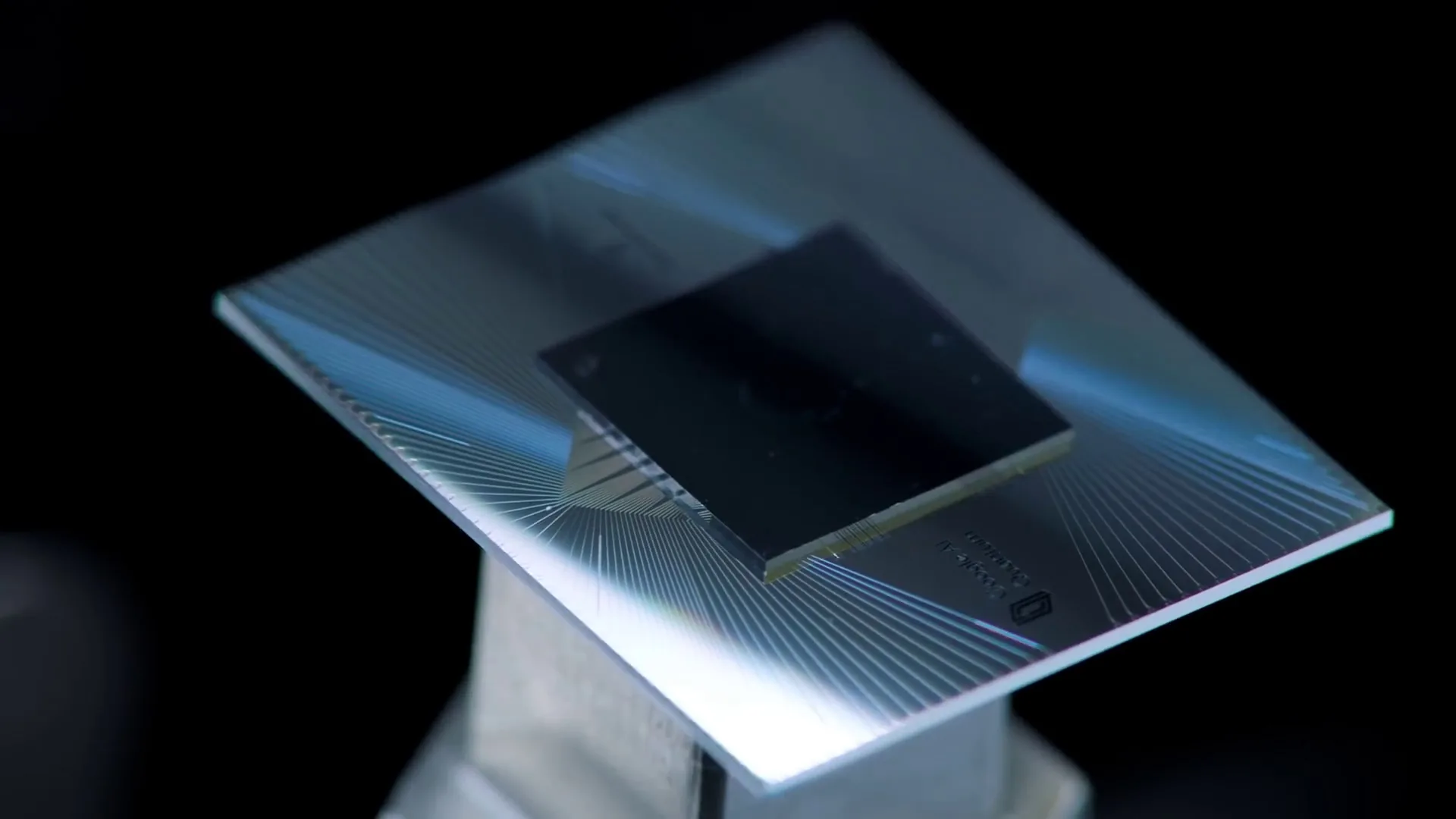
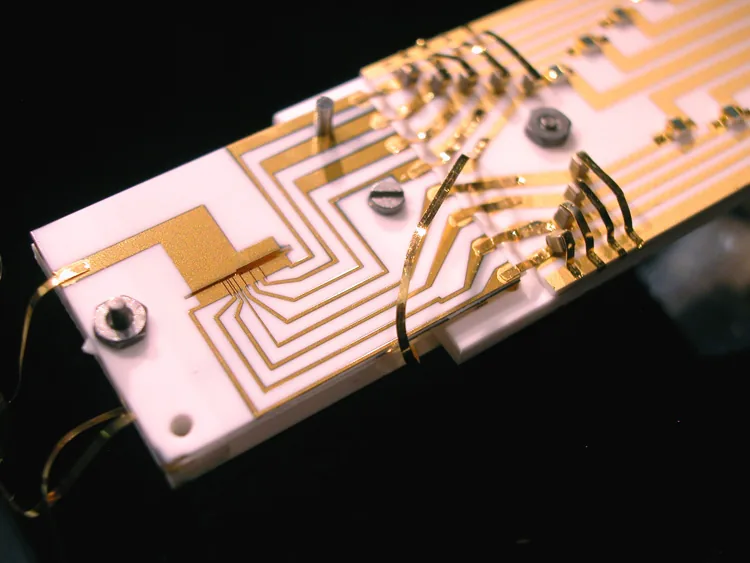
John Clarke, Michel Devoret and John Martinis shared the 2025 Nobel Prize in Physics for 1980s experiments showing that a superconducting circuit, an object containing billions of electrons, behaves as a single quantum system with discrete energy levels. That is the fact a superconducting qubit is built on. Devoret later helped design the transmon, the circuit most such qubits use, and Martinis led Google’s hardware team through the Sycamore experiment.
Noise and Decoherence
Nothing is perfectly isolated. A stray magnetic field, a vibration, a bit of heat or an imperfect control pulse nudges the qubit’s arrow on the sphere, and the stored amplitudes drift away from their intended values. Physicists summarise this with two times: how long a qubit holds its energy state, and how long it holds its phase. Both are called coherence times, and a computation has to finish well within them. Gates add their own errors on top, and the two-qubit gates that create entanglement are the worst.
| Platform | Gate time | Coherence time | Two-qubit gate error |
|---|---|---|---|
| Superconducting | 20 to 100 nanoseconds | 0.1 to 1 millisecond | 0.1% to 0.5% |
| Trapped ions | 10 to 100 microseconds | Seconds to minutes | About 0.1%, with the best reported below that |
| Neutral atoms | About a microsecond | Seconds | About 0.5% |
Read the ratio, not the absolute. A superconducting qubit runs about ten thousand gates before its coherence time is up; a trapped ion runs a similar number, just more slowly. In both cases, an error rate of 0.1% per gate means that after a thousand gates the computation is probably wrong. Shor’s algorithm needs billions. No physical qubit on any platform comes close, which is why error correction is not an optimisation but the whole project.
Error Correction: Many Qubits, One Logical Qubit
Classical computers correct errors by copying: store a bit three times and take the majority. Qubits cannot be copied, and reading them to check destroys the state. Quantum error correction gets around both problems. It spreads one logical qubit’s state across many physical qubits in an entangled pattern, then repeatedly measures relationships between neighbours rather than the qubits themselves. The pattern of those checks, the syndrome, reveals which physical qubit slipped and how, without revealing the logical value. A correction is then applied, or simply noted for later.
The most studied scheme is the surface code: data qubits on a square grid with check qubits between them, where every check involves only its four nearest neighbours. Its distance is the width of the grid. A distance-d code corrects up to (d−1)/2 errors per round, so a bigger grid tolerates more errors, but a bigger grid also contains more qubits that can fail. Which effect wins depends on the physical error rate.
That dependence is the threshold. Above a certain physical error rate, roughly 1% for the surface code, bigger patches make things worse. Below it, each increase in distance multiplies the logical error rate by a fixed factor smaller than one, and the logical qubit can be made as reliable as the application needs by adding physical qubits. Google’s Willow experiment, reported in December 2024, was the first to show this cleanly: logical error per cycle fell from about 0.65% at distance 3 to about 0.31% at distance 5 and 0.143% at distance 7, a factor of 2.14 per step, on a 105-qubit chip.
Below threshold is the start, not the finish. At Willow’s error rates a logical qubit good enough for Shor’s algorithm would need a distance in the twenties, which is roughly a thousand physical qubits per logical qubit, and the 2025 RSA-2048 estimate of under a million physical qubits assumes exactly that kind of overhead. IBM is pursuing a different family of codes, quantum LDPC codes, that promise a smaller overhead at the cost of longer-range connections between qubits. Trapped-ion machines, with their all-to-all connectivity, have demonstrated dozens of error-corrected logical qubits at once, but at small distances and for short computations.
The Numbers Behind the Headlines
| Machine | Platform | Physical qubits | What it showed |
|---|---|---|---|
| Google Sycamore (2019) | Superconducting | 53 | The first beyond-classical sampling claim, later narrowed by better classical methods. |
| IBM Condor (2023) | Superconducting | 1,121 | The largest qubit count on one chip; IBM then shifted to smaller, better-connected processors such as the 156-qubit Heron. |
| Atom Computing (2023) | Neutral atoms | 1,180 | The first array past a thousand qubits, showing how neutral atoms scale. |
| Google Willow (2024) | Superconducting | 105 | Error correction below threshold; in 2025, a verifiable-advantage physics measurement. |
| Quantinuum Helios (2025) | Trapped ions | 98 | Company-reported two-qubit fidelity of 99.921%; 94 error-detected and 48 fully error-corrected logical qubits. |
Qubit counts alone mislead. Condor has ten times Willow’s qubits and demonstrated less, because its error rates were higher and its qubits less connected. The useful comparison is how many logical qubits a machine can sustain, at what logical error rate, for how many gates. On that scale every machine in the table is still in the single or double digits.
Reading a Roadmap
Vendor roadmaps now talk in logical qubits. IBM’s June 2025 plan targets a machine called Starling for 2029, with about 200 logical qubits able to run 100 million gates. Google’s stated goal is a useful error-corrected computer on the order of a million physical qubits. Quantinuum, IonQ and the neutral-atom companies publish similar multi-year plans. When you read one, ask four questions: physical or logical qubits; what two-qubit error rate; how many gates before the logical error accumulates; and whether the number has been demonstrated or only planned.
For encryption the practical conclusion does not depend on which roadmap is right. The machine that breaks RSA-2048 or P-256 is years away and may be many years away, but the data it would decrypt is being recorded now. That is why post-quantum encryption is deployed before the hardware exists, and why OWL already wraps recipient keys with ML-KEM-768 alongside P-256.
Sources & Further Reading
- D. P. DiVincenzo, “The Physical Implementation of Quantum Computation”, Fortschritte der Physik 48, 771 (2000).
- Google Quantum AI and collaborators, “Quantum error correction below the surface code threshold”, Nature 638, 920 (2025); preprint arXiv:2408.13687. The per-cycle error rates and the factor of 2.14 come from this paper.
- A. G. Fowler, M. Mariantoni, J. M. Martinis and A. N. Cleland, “Surface codes: Towards practical large-scale quantum computation”, Physical Review A 86, 032324 (2012).
- Google, “Meet Willow, our state-of-the-art quantum chip” (December 2024).
- Quantinuum, “Introducing Helios” (November 2025). Figures are company-reported.
- IBM, IBM Quantum roadmap, including the June 2025 Starling announcement.
- The Nobel Prize in Physics 2025: press release.
- The Quantum Atlas: How to Make a Qubit and Quantum Error Correction, Joint Quantum Institute, University of Maryland.
- C. Gidney, “How to factor 2048 bit RSA integers with less than a million noisy qubits”, arXiv:2505.15917 (2025): the overhead assumptions behind the million-qubit figure.
Hardware figures reflect vendor announcements and peer-reviewed papers available in October 2026 and will date quickly. Treat every number as a snapshot.